US B1 B2 Visitor Visa Interview Questions and Preparation
US consulates now ask all visa applicants about harm and fear of returning home.
Every B1/B2 interview, whether it runs ninety seconds or five minutes, tests the same four things: why the applicant wants to go to the US, what ties them home, whether their finances add up, and whether the story holds together against the paperwork already on file. Applicants who treat the interview as a script to memorize tend to miss this. Officers aren't grading English fluency or rewarding a polished answer; they're checking a fixed set of risk factors against a DS-160 they've already read before the applicant reaches the window.
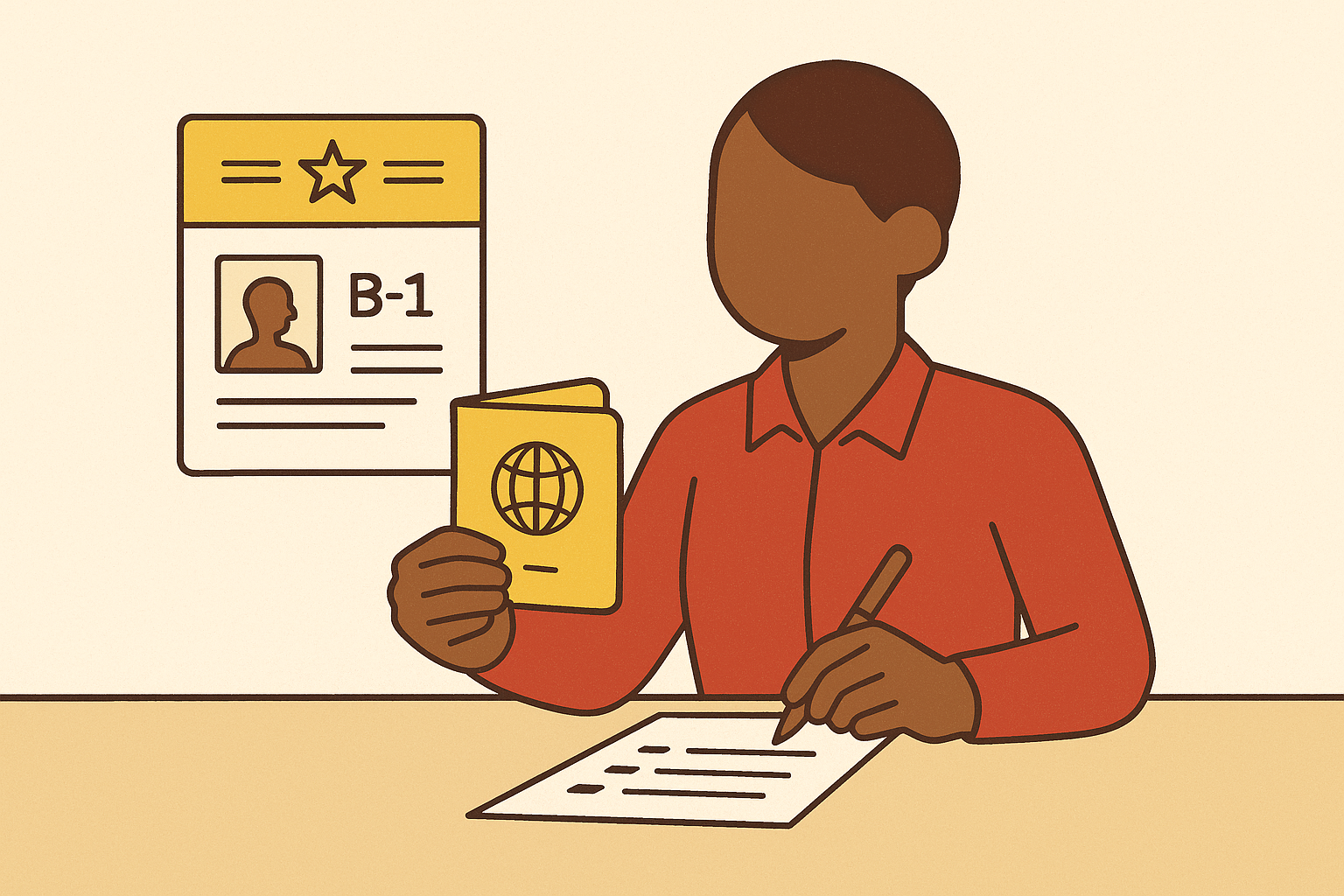
The B1/B2 is really two visas stapled into one document: B-1 covers short business trips (meetings, conferences, contract talks, no US-source income), and B-2 covers tourism, family visits, and medical treatment. Most applicants get it issued for multiple entries, and depending on nationality, validity can run for multiple years, though each individual stay is capped at whatever the officer at the port of entry decides, usually up to six months. None of that generosity on the validity side changes what happens at the interview window. That part stays short, blunt, and entirely about credibility.
What the interview looks like in practice
A consular officer at a US Embassy or Consulate runs the interview, and it typically lasts two to five minutes. Four to eight questions is the norm, and the officer usually reaches a decision in under 90 seconds of actual conversation. That brevity isn't a sign the process is being rushed or shortchanged; it's the design. The officer already has the DS-160, the fingerprints, and the supporting documents pulled up before the applicant sits down, so the interview itself is aimed at whatever gaps or red flags that paperwork left open, not a general biography check.
Three outcomes come out of that window. The visa gets approved, it gets refused (most often under Section 214(b), covered below), or the case goes into administrative processing under Section 221(g). That means additional review before a final decision. Applicants who walk in expecting a conversation should recalibrate: this is closer to a rapid-fire consistency check, and answers need to land immediately and precisely, not build up to a point.
The new mandatory harm and fear questions added in 2026
On April 28, 2026, the State Department sent a cable to every US consulate instructing officers to ask two standardized questions of all nonimmigrant visa applicants, tourists included:
"Have you experienced harm or mistreatment in your country of nationality or last habitual residence?"
"Do you fear harm or mistreatment in returning to your country of nationality or last habitual residence?"
The directive was signed by Secretary of State Marco Rubio and traces back to a 2025 Trump executive order. The stated goal is to screen for asylum-relevant facts before someone enters the US on a tourist or business visa and later tries to convert that status once inside the country. Answering "yes" to either question typically results in an on-the-spot denial, and this isn't limited to applicants who arrive with an obvious asylum-adjacent story. The questions go to everyone: B1/B2 tourists, students, temporary workers, the whole nonimmigrant pool. That's a structural change to the interview, not a minor addition, because it inserts a binary screening question into a process that used to be built entirely around discretionary judgment calls about intent and ties.
Purpose of travel questions: what "specific and credible" requires
The purpose-of-travel questions sound simple on paper. What is the purpose of the visit? How long is the stay? Where will the applicant be staying? Who are they visiting? Have flights and hotels been booked? Is this a solo trip or is someone traveling along? None of these is hard to answer honestly. The trouble is that vague, generic answers, something like "I want to see America," are one of the most common triggers for a 214(b) refusal, because they give the officer nothing specific to check against the file.
Specificity has to match what's already sitting in the DS-160. The officer has read that form before the applicant reaches the window, and the interview is largely a listening exercise for contradictions between what's written and what's said out loud.
B-1 business applicants carry an extra layer of risk here. The visa permits attending meetings, conferences, consultations, and contract negotiations, but it does not permit employment or productive work performed for a US employer. That line, between legitimate business activity and actual employment, can be genuinely hard to draw, and applicants sometimes describe their trip inaccurately even when they believe, in good faith, that the purpose is squarely business. An invitation letter from the US company helps close that gap: it should name the invitee, state their title, spell out the purpose and duration of the visit, identify who's funding it, and carry a signature or company stamp. Without that document, the officer is left to take the applicant's characterization of "business" on faith, which is exactly the kind of unverifiable claim the interview format is built to avoid.
Ties to home country: the evidence that overcomes the 214(b) presumption
Section 214(b) of the Immigration and Nationality Act starts from a presumption that every visitor-visa applicant intends to immigrate, and it's on the applicant to prove otherwise. A large share of B1/B2 refusals fall under this section, which makes it one of the most important legal concepts an applicant needs to understand walking in.
The questions built around this presumption probe for a web of obligations: Is the applicant married? Do they have children, and do those children travel with them or stay behind, and why? Do they own property? Where does the applicant's family live? What employment, family, property, or other commitments exist outside the US? What happens after the trip ends, and who runs the applicant's job or business while they're away?
None of this is really about any single answer. The officer is looking for a pattern of obligations that makes returning home the rational, almost inevitable outcome. A few applicant profiles draw heightened scrutiny under this framework: vague travel purposes (discussed above), close relatives in the US who hold permanent residency or citizenship (which raises the specter of immigrant intent), and young, single, unemployed applicants who simply have fewer anchors holding them to their home country. None of these factors is automatically disqualifying, but each one shifts the burden of proof further onto the applicant to show a countervailing tie.
Financial capacity questions
Money questions in the interview aren't about wealth. They're about whether the applicant can pay for the trip without needing to work illegally in the US or become dependent on public assistance while there. Who's paying for the trip? What does the applicant do for work, and for how long have they done it? What's the monthly income? Are there savings? What does the applicant expect the trip to cost, and do they carry a credit card? Can they produce evidence of income and financial stability?
Consistency matters as much as the raw numbers. An officer listening to a stated income figure is also mentally checking it against the bank statements and the DS-160 sitting in front of them, and a mismatch there reads as a credibility problem even if the underlying finances are perfectly sound.
Sponsored trips add a layer. If someone else is footing the bill, the applicant needs to clearly establish the relationship to that sponsor and be able to describe the sponsor's job and finances accurately, not vaguely gesture at "a relative helping out." Bank statements, tax returns, an employment letter that states the salary, and property records where relevant should back up whatever the applicant says out loud. None of these documents replaces the interview answer, but each one gives the officer something concrete to check the answer against.
Prior travel history and family-in-the-US questions: how past behavior frames the present application
Travel history functions as a track record, and officers can pull I-94 records to verify it, so applicants should know their own dates cold before walking in. Standard questions here: Has the applicant traveled outside their home country before? Have they been to the US, and if so when, and for how long? Has any visa application ever been refused? Has the applicant ever overstayed a visa anywhere, or been refused admission to or removed from the US?
A clean record, meaning trips taken and return dates honored, counts as strong positive evidence. It's the single clearest signal an officer can check against something other than the applicant's own testimony. A prior refusal or a past overstay doesn't automatically sink an application, though; the effect depends on the specific circumstances and whether those circumstances create a current, standing ground of ineligibility. Applicants with a blemish in their travel history are generally better served explaining it directly than hoping it goes unnoticed, since the record is already sitting in front of the officer either way.
Family-in-the-US questions round out this section: Does the applicant have family already living in the US, and if so, are those relatives citizens, permanent residents, or on their own visas? This ties directly back into the 214(b) analysis, since close family already settled in the US, particularly with permanent status, is one of the factors that can raise the immigrant-intent concern discussed earlier.
Where the interview framework breaks down, according to refusal rates
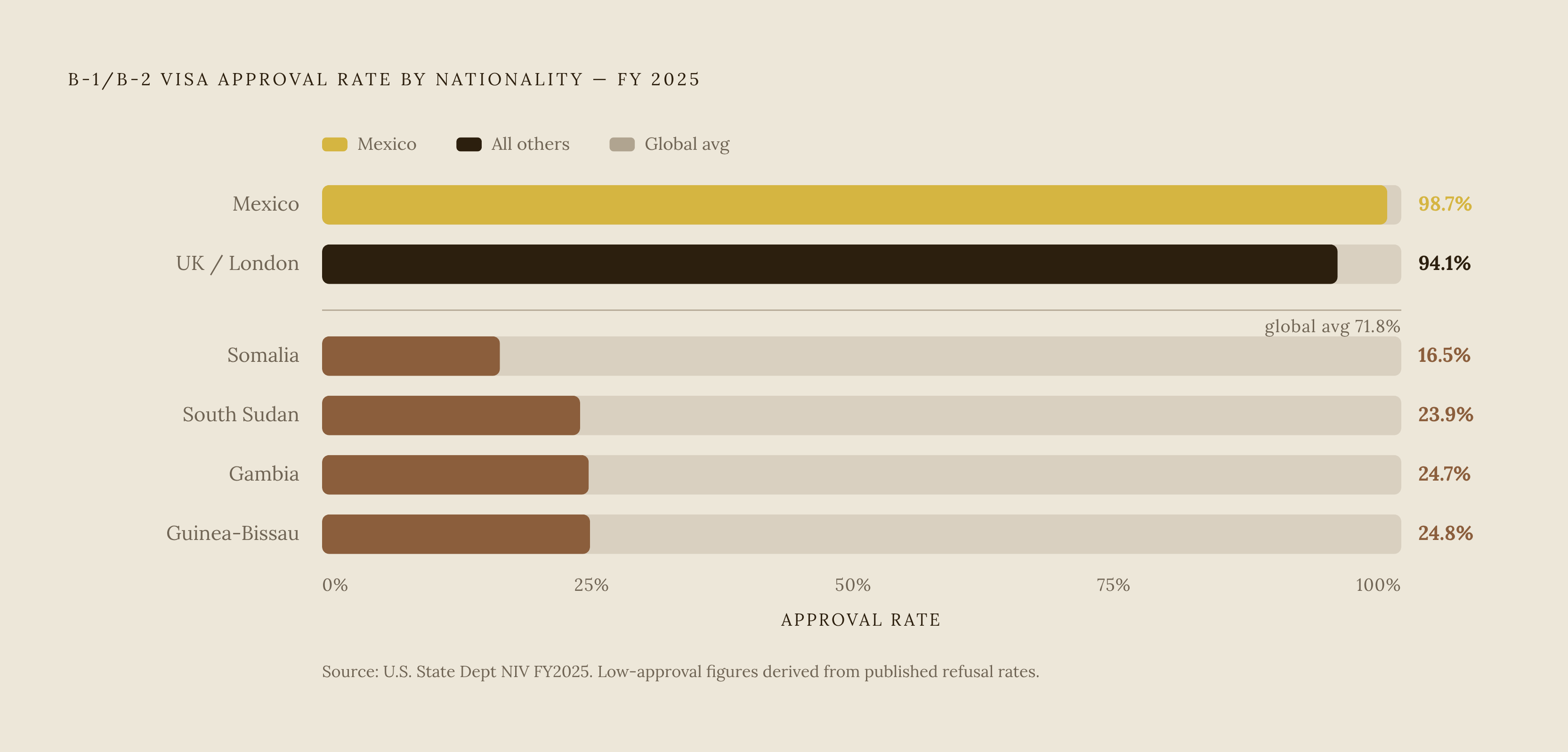
In FY2025, the State Department processed 8,742,563 B-1/B-2 applications worldwide and issued 6,278,401 visas, a global approval rate of 71.8%, but that headline number flattens a huge spread by... In FY2025, the State Department processed 8,742,563 B-1/B-2 applications worldwide and issued 6,278,401 visas, a global approval rate of 71.8%. That headline number, though, flattens a huge spread by nationality and by post, and the spread is really where the interview framework's real-world logic shows itself.
Mexico posted a 98.7% approval rate on 3.2 million applications in FY2025, and the US Embassy in London processed 487,000 applications at a 94.1% approval rate. Compare that against Somalia at an 83.52% refusal rate, South Sudan at 76.09%, Gambia at 75.29%, Guinea-Bissau at 75.17%, and Senegal with a refusal rate not far behind the others in this group. These aren't random variations. They track almost exactly with the 214(b) framework described above: applicants from countries with weaker economic ties, less stable documentation infrastructure, or historical patterns of visa overstay face a presumption of immigrant intent that's structurally harder to overcome, regardless of how well any individual applicant answers the four to eight questions asked at the window.
That gap between a 98.7% approval rate and a refusal rate running close to it in the other direction is a story about how unevenly the burden of proof under 214(b) falls once nationality, economic context, and prior travel patterns get factored into an officer's ninety-second judgment call. It's a story about how unevenly the burden of proof under 214(b) falls once nationality, economic context, and prior travel patterns get factored into an officer's ninety-second judgment call.