EU Entry Exit System Impact on Schengen Border Crossings
Biometric checks boost security data but have slowed European border crossings significantly.

The EU Entry/Exit System replaces the passport stamp with a biometric record, recording fingerprints, a facial scan, and a digital log of every entry and exit for non-EU nationals crossing into the Schengen Area. It started rolling out on October 12, 2025, and by April 2026 it was supposed to be running at full strength across all 29 participating countries. What it actually delivered in that window was a border system that is more precise about who overstays and, at the same time, considerably slower for almost everyone passing through it.
The old method never really worked, not in any way that produced usable data. An officer stamped a passport, and that stamp lived on paper, in a passport, in a traveler's pocket, unconnected to any central database that could tell you, with confidence, who was still in the country six months later. The European Commission has said as much directly: manual stamping was slow and unreliable as a way of generating real border-crossing data. With an enormous volume of third-country national crossings flowing through Schengen borders each year, that manual process was buckling under its own weight even before anyone tried to fix it.
What EES applies to at the border
EES applies to non-EU, non-Schengen nationals making short stays, meaning up to 90 days within any rolling 180-day window. That calculation is done as a single running total across all 29 EES states. It's a single running total across all 29 EES states, which is a meaningfully different way of tracking time than the old stamp-by-stamp system ever allowed.
The system covers all 29 Schengen countries, from Austria through Switzerland. Cyprus and Ireland are EU members but sit outside Schengen, so neither one runs EES. A handful of travelers are carved out entirely: anyone holding a long-stay visa or a residence permit is exempt, as are non-EU citizens already legally resident in a member state.
For everyone else, the data captured at the border is substantial. Full name, date of birth, nationality, travel document details, the date and place of every entry and exit, a facial image, fingerprints, and a record of any prior refused entry all get logged into the system. That's a far more granular file than a stamp ever produced, and it's the reason the system can now answer questions about overstay rates that were previously unanswerable.
The rollout timeline: from October 2025 launch to the April 2026 completion
EES has been delayed so many times it's almost become a running joke among border policy watchers. The original target was 2022. May 2023 came next. Then late 2023. Then late 2024. Each postponement traced back to IT systems that weren't ready, and the final delay added a new wrinkle: member states themselves asking for more time. Germany, France, and the Netherlands all said their border computer infrastructure wouldn't be ready for the November 2024 deadline, and France specifically wanted to push things past the 2024 Paris Olympics.
The system finally launched on October 12, 2025, though "launched" undersells how uneven that day actually was. Some countries connected fully from the first hour. Others brought EES online progressively, airport by airport, seaport by seaport, land crossing by land crossing.
Dover became something of a case study in how messy this rollout got. Car passengers at Dover had their EES processing pushed to November 2025, then paused again after French police withheld approval for the checks to proceed. Eurotunnel, meanwhile, started EES checks for coaches and freight right on schedule, October 12. Dover then delayed its border checks again, this time specifically to avoid disruption during the Christmas travel period, pushing full implementation into 2026.
What enrollment and border crossing look like in practice
At any crossing where EES is live, the sequence starts the same way every time: the passport or biometric travel document gets scanned first. What happens next depends on whether the system has seen that traveler before.
First-time crossings mean a stop at a dedicated kiosk or an officer's station, where a facial image and fingerprints get captured and logged alongside the travel document and entry point. That's the enrollment step, and it's the one that takes the most time, since it's building a record from scratch.
Return visits are supposed to be quicker. The system just checks a traveler's biometrics against what's already on file, rather than capturing new data. In principle, that's a faster process than the first crossing. In practice, it depends entirely on how many kiosks are open and how long the queue already is. Self-service kiosks exist at some crossings but not all of them, and where a kiosk is missing or broken, the whole thing reverts to a manual process handled by a border officer, which is slower than either automated path.
The delay problem: how border processing times changed after EES activation
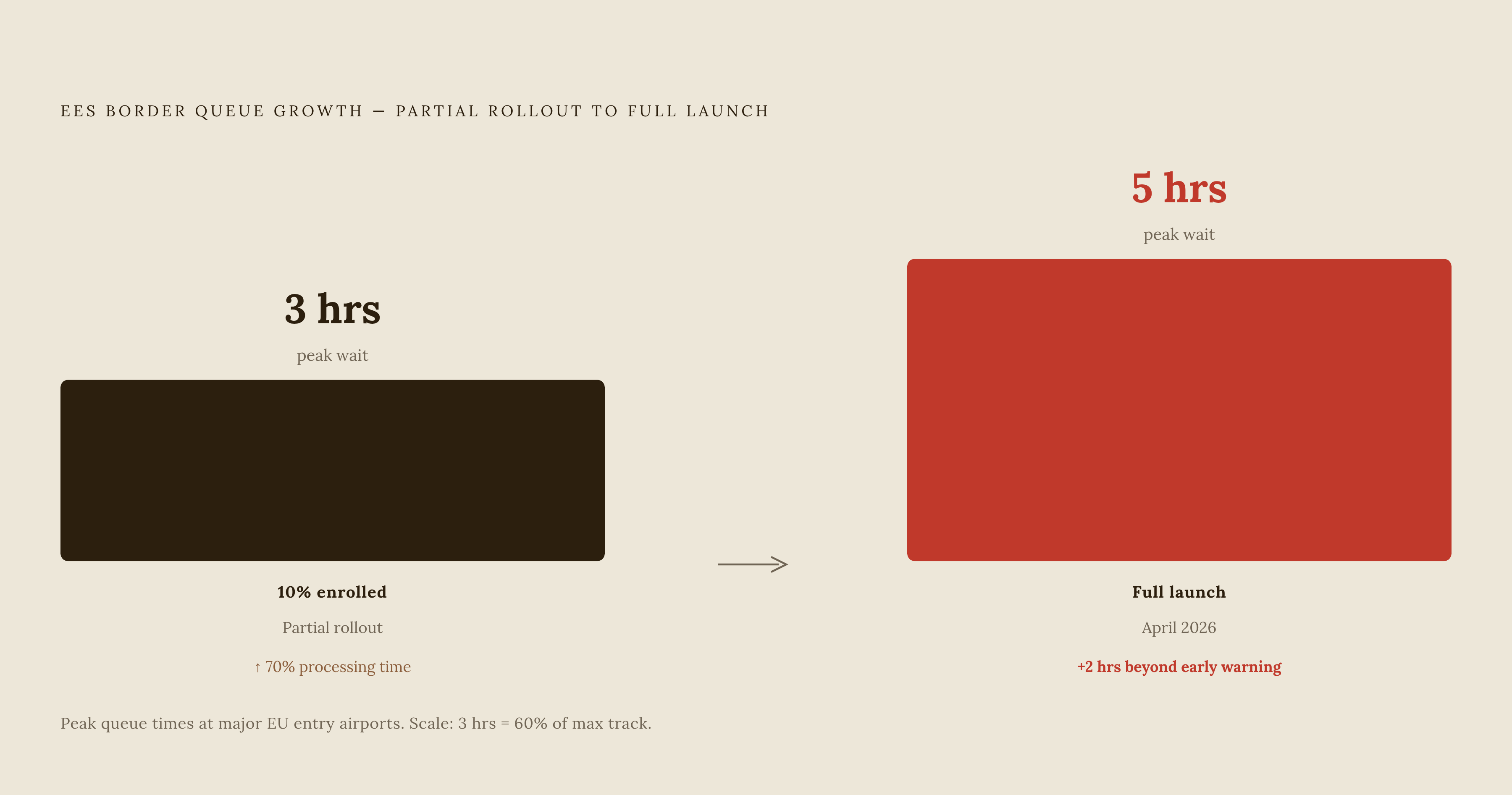
The data on wait times is not subtle. ACI Europe found that as biometric data collection scaled up progressively, airport border processing times rose by as much as 70%, with peak-period waits stretching up to three hours. Airports in France, Germany, Greece, Iceland, Italy, Portugal, and Spain took the worst of it.
What makes that number striking is the context: this happened while the registration threshold was still capped at just 10% of eligible travelers. The heavier phases of the rollout hadn't even started yet.
Once the system reached full launch in April 2026, the picture got worse before it got better. Border lines reportedly ran as long as five hours during peak travel windows after the full April 2026 launch. The human cost of those delays translated directly into disruption for travelers throughout the affected airports.
Industry pushback, suspension mechanisms, and the limits of the Commission's response
By February 2026, the aviation industry had stopped being patient about it. Aviation industry groups including ACI Europe and Airlines for Europe (A4E) warned that without immediate intervention, queues could hit four hours or more once peak summer travel arrived. Their statement didn't mince words: "There is a complete disconnect between the perception of the EU institutions that EES is working well, and the reality, which is that non-EU travelers are experiencing massive delays and inconvenience." A4E went further, calling it a systemic failure rather than a teething problem, a distinction that matters because a teething problem implies it fixes itself with time.
The tools available to fix it got narrower right when they were needed most. Before April 10, 2026, border authorities had the option to suspend EES entirely if queues became unmanageable, reverting temporarily to the old manual process. That full suspension option disappeared at full launch. What's left is a partial suspension: officers can skip the biometric collection step while still keeping a digital record, which trims processing time while keeping the system in place. It's a narrower tool, and industry groups have made clear they don't think it's enough on its own.
EES and the 90/180-day rule and overstay enforcement
Overstay enforcement is where EES actually earns its keep, whatever the queue times cost travelers on the front end. Before the system existed, nobody could say with real confidence how many people were overstaying their welcome in the Schengen Area, because the underlying data was never digitized or cross-referenced country by country. A stamp could be missed. A stamp could be forged. Two stamps from two different countries were never going to talk to each other.
EES fixes that by treating the 90/180-day rule as one continuous calculation spanning all 29 countries at once. When a traveler tries to exit or re-enter, the system checks the running total automatically and flags anyone who has gone over, without an officer needing to do the math by hand.
The numbers from early operation give some sense of scale. Figures released in February 2026 showed the system had processed roughly 17 million travelers and logged 30 million border crossings by that point. About 16,000 people had been refused entry, and roughly a quarter of those refusals, somewhere around 4,000, were tied specifically to overstay violations. That's four months of data producing a clearer overstay picture than the old paper system ever managed to produce.
Specific implications for British travellers after Brexit
British nationals lost their EU citizenship status for border purposes after Brexit, and under EES that is visible in a very concrete way: Brits are now processed as third-country nationals, same as travelers from any other non-EU, non-Schengen country. The only people exempt are British citizens legally resident in the EU or covered under the Withdrawal Agreement's specific terms.
For most UK travelers, that means full biometric enrollment on the first Schengen crossing after EES went live, and the 90/180-day rule tracked digitally on every trip after that. It's a meaningful shift from the old stamp-based system, where a British passport got treated more casually simply because the enforcement mechanism behind it was weaker.
The UK government has taken notice. In late March 2026, it advised travelers to build in extra time for border crossings and said it was "engaging with the European Commission on taking steps to help minimise disruption for Brits as much as possible." Dover and the Channel crossings sit at the center of this story, given how much British travel to the continent runs through that corridor. The delay of Dover's border checks until 2026, specifically to sidestep Christmas chaos, and both point to a crossing point still working out how to absorb the system without grinding to a halt.
Privacy, data governance, and the civil liberties questions EES raises
The amount of personal data EES holds is not small, and it doesn't disappear quickly. Name, passport details, facial image, fingerprints, and a complete entry-exit history are in a central system run by eu-LISA for three years, or five years for anyone flagged as an overstayer. That's a long retention window for biometric data tied to an identified individual.
Access isn't limited to border officers checking a passport. National border and immigration authorities can use it, and so can Europol, which can cross-reference fingerprints lifted from crime scenes against the EES database. That's a genuine expansion of what the system does. EES was built to manage borders, and now it doubles as an investigative tool for law enforcement, which is a different function entirely from the one the system was originally sold on.
Regulation (EU) 2017/2226 does build in safeguards. Access is restricted to authorized authorities, and oversight is provided both by national bodies and by a broader data protection authority operating at a higher governmental level. Critics still raise fair concerns: automated systems carry real risk of profiling or discriminatory flagging, and a missing exit record, say from a kiosk malfunction or a system outage, could wrongly mark someone as an overstayer through no fault of their own. Whether that gets corrected quickly depends on which country's legal system a traveler happens to be dealing with, since redress mechanisms vary by national law rather than operating as one uniform process spanning every member country.
What travellers should understand before crossing a Schengen border now
The practical reality right now is uneven, and travelers should plan around that unevenness rather than assume a single, predictable experience. Border crossing under EES looks different depending on which airport, seaport, or land crossing a traveler uses, since some points reached full deployment faster than others and some still lean on manual backup when kiosks fail.
Building in extra time at the border is the single most useful thing a traveler can do, particularly during peak season when queues have already stretched to hours at some airports. First-time crossings take longer because of the enrollment step, so anyone crossing into the Schengen Area for the first time since October 2025 should expect that first encounter with EES to take noticeably longer than the return trip will.
British travelers in particular should treat the 90/180 day rule as a hard digital limit now. The system tracks it automatically, across all 29 countries, and it flags violations without requiring anyone to manually count days. Anyone planning frequent or extended trips into the Schengen Area would do well to track their own days spent inside it, given that the system now does the same math without margin for a forgiving officer to look the other way.
Sources
- Launch of the EU’s new Entry/Exit System (EES) from 12 October 2025 – the impact on travellers to the Schengen area
- EU’s new Entry/Exit System will make Europe safer for all
- EU Entry/Exit System Implementation Forthcoming
- The EU Entry/Exit system and EU travel authorisation system - House of Commons Library
- EES rollout leaves passengers waiting up to 3 hours at airports
- With start of operation of new EES border control system the EU will strengthen border security and increase efficiency for travellers - Consilium
- The Entry Exit System is fully operational since 10 April 2026. Who is exempt?
- Entry-Exit System