Kenya Electronic Travel Authorization for All Arrivals
Kenya's mandatory eTA replaced visa-on-arrival but exemptions keep shifting.

Kenya now requires every foreign visitor, regardless of nationality, to secure an Electronic Travel Authorization before departure. That rule took effect in January 2024, and it replaced the old visa-on-arrival system that travelers had relied on for years. Understanding who actually has to apply, what the application demands, and where the process still trips people up matters more than it might seem, because the exemption list has changed twice since launch and a wrong assumption at check-in can mean denied boarding.
The origin of the policy sits in two announcements from the country's president. On October 28, 2023, he said Kenya would drop visa requirements for all African visitors by the end of the year. Then, on December 12, 2023, during Kenya's 60th Independence Day, he widened that decree to cover every country on earth, effective the following month. What actually launched in January 2024 wasn't a visa-free regime in the way many read the announcement. Kenya swapped its visa-on-arrival process for a mandatory eTA, run by the Ministry of Interior and National Administration through the State Department for Immigration and Citizen Services, Directorate of Immigration Services. The distinction matters: an eTA is not a visa, but it is not optional either, and it has to be approved before the traveler ever boards a plane.
Who needs to apply, and who is already exempt
The baseline is simple and applies to nearly everyone: every visitor, including infants and children, needs an approved eTA before departure. Skipping it risks a traveler being turned away at boarding or hit with a penalty fee on arrival.
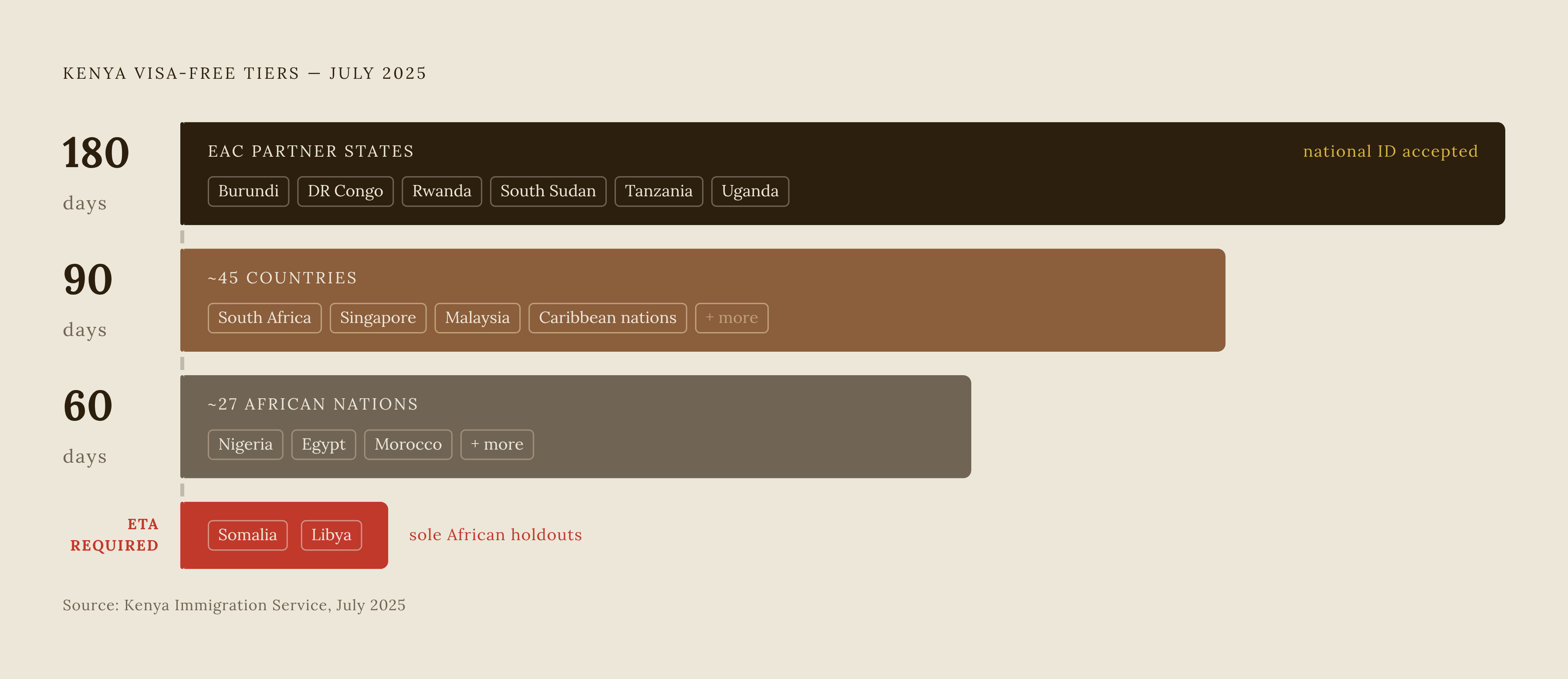
The exceptions, laid out in the Kenya Citizenship and Immigration (Amendment) Regulations, 2025, are where things get specific. Citizens of the East African Community's partner states (Burundi, DR Congo, Rwanda, South Sudan, Tanzania, and Uganda) get a 180-day exemption and can even enter using a national ID card instead of a passport.
A second group of mostly non-African countries gets a 90-day exemption. That list runs long: the Bahamas, Barbados, Belize, Botswana, Brunei, Comoros, the Republic of Congo, Cyprus, Dominica, Eritrea, Eswatini, Ethiopia, Fiji, Gambia, Ghana, Grenada, Guyana, Jamaica, Kiribati, Lesotho, Malaysia, the Maldives, Malawi, Mauritius, Mozambique, Namibia, Nauru, Papua New Guinea, Saint Kitts and Nevis, Saint Lucia, Saint Vincent and the Grenadines, Samoa, San Marino, Seychelles, Sierra Leone, Singapore, the Solomon Islands, South Africa, Tonga, Trinidad and Tobago, Tuvalu, Vanuatu, Zambia, and Zimbabwe.
A third group, mostly African nations, gets a 60-day exemption: Algeria, Angola, Benin, Burkina Faso, Cape Verde, Cameroon, the Central African Republic, Chad, Côte d'Ivoire, Djibouti, Egypt, Equatorial Guinea, Gabon, Guinea, Guinea-Bissau, Liberia, Madagascar, Mali, Mauritania, Morocco, Niger, Nigeria, Sao Tome and Principe, Senegal, Sudan, Togo, and Tunisia.
Somalia and Libya stand alone as the only African nations whose citizens still need an eTA, with security cited as the reason.
A few narrower categories round out the exemptions. Transit passengers who arrive and leave on the same aircraft, or who transfer to another flight without leaving the airport, don't need one. Crew members on ships, aircraft, trains, or other carriers, as long as they're on the manifest and heading somewhere outside Kenya, are also exempt, as are private aircraft owners who stop only to refuel and never leave the airport grounds. Kenya residents holding a permanent residence certificate, a valid work permit, or a valid pass endorsed in their passport round out the list.
Evolution of the exemption list from January 2024 through July 2025
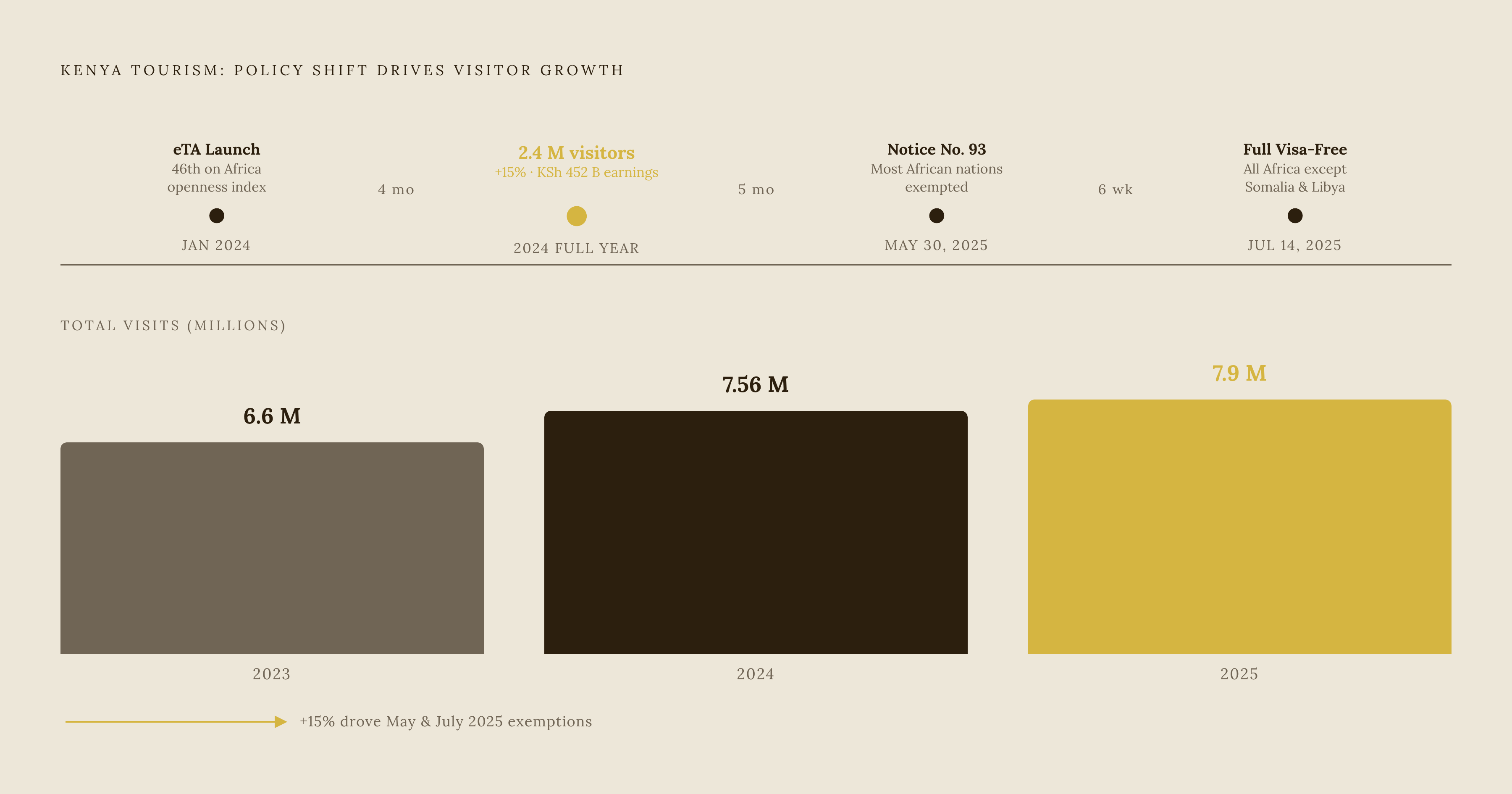
The system Kenya launched in January 2024 was far stricter than what exists now. At the start, only EAC citizens and a short list of mostly Commonwealth and Pacific-island countries were exempt. That meant travelers from the US, the UK, the EU, most of Asia, and nearly every African country outside the EAC bloc had to apply for an eTA just like everyone else.
That changed on May 30, 2025, when the Cabinet Secretary for Interior and National Administration issued Legal Notice No. 93. The amendment effectively exempted every African nationality except Somalia and Libya, and added a handful of Caribbean nations to the list as well. The notice bluntly pointed to "efforts to support open skies policies and tourism growth."Then, on July 14, 2025, Kenya went further and exempted nationals of African countries from the eTA requirement, allowing visa-free entry for up to 90 days with no online approval step and no fee to pay, except for Libya and Somalia, which remain the lone holdouts.
The timing lines up with an uncomfortable data point. A continental body's visa openness index showed Kenya's ranking fall from 29th to 46th following the eTA rollout, a drop that flagged Kenya as harder to enter than it had been under the old visa-on-arrival system. The May and July 2025 changes read less like a policy refinement and more like a direct answer to that criticism.
What a standard eTA application requires and costs
For travelers who still need one, there's exactly one legitimate place to apply: etakenya.go.ke. Every other site claiming to offer the service is unauthorized, and some are outright fraudulent.
Applications open up to 90 days before travel and need to go in at least 3 days ahead of departure. The core paperwork is the same for nearly everyone: a passport valid for at least six months past the planned arrival date, a selfie or passport-style photo, an email address and phone number, arrival and departure itinerary details, proof of accommodation (or an invitation letter if staying with someone), a credit or debit card for payment, and a Yellow Fever vaccination certificate for anyone arriving from a country where yellow fever risk applies.
Beyond that baseline, the paperwork shifts depending on why someone's traveling. Business travelers need an invitation letter from the Kenyan company they're visiting along with supporting documentation from that company. Someone visiting family needs an invitation letter from the host along with supporting identification documentation from the host. Medical travelers need a referral or appointment letter from the hospital. Conference attendees need an invitation or participation letter. Diplomatic travelers need a diplomatic, official, or service passport plus an official letter from their country or organization. Minors need a copy of a parent's passport bio-data page and a consent letter. Anyone applying for multiple entries needs a letter explaining why, or a recommendation from an employer or organization.
The East African Tourist Visa as an alternative for multi-country itineraries
For travelers planning to hit more than one country in the region, the East African Tourist Visa, in place since February 2014, covers Kenya, Rwanda, and Uganda under one application. It costs $100 and is open to most nationalities that would otherwise need a visa to enter any of the three countries.
The visa is multiple-entry, valid for 90 days, and cannot be extended. One detail trips up more travelers than it should: the visa must be used to enter the issuing country first. A traveler who applies through Kenya has to enter Kenya before Rwanda or Uganda, not the other way around, and getting that sequence backward can undo the whole plan.
Scam sites and the risks of applying outside the official portal
The Directorate of Immigration Services has been explicit that etakenya.go.ke is the only site where an eTA application is valid. That warning exists because copycat sites multiply every high season, and some of them are built well enough to fool a careful traveler, complete with references to President Ruto and images of Kenyan landmarks meant to look official.
Applying through one of these sites carries real financial risk. Travelers have reported being overcharged, having payment details stolen, or receiving a fraudulent "approval" that later gets them denied boarding entirely, since it was never issued by the actual immigration authority.
A few signs should make any traveler stop and check the address bar. A domain that isn't etakenya.go.ke is the clearest one. A price meaningfully above the standard $34.09 fee is another. Any site promising a guaranteed approval or claiming it can skip past the standard 3-day processing window is not operating on behalf of the Kenyan government, no matter how official it looks.
Common application pitfalls
Timing trips up more applicants than any other factor. Submitting fewer than 3 days before travel risks the application not clearing in time, and processing can run past that official 3-day window even when everything is filled out correctly, so applying with a buffer isn't optional; it's the safest default.
Passport validity is another quiet failure point. The rule (six months of validity past the arrival date, plus one blank page) is easy to overlook for travelers whose passports are getting close to expiry, and this detail often only becomes a problem after the application's already been submitted.
Missing documents by travel purpose account for a good share of delays too. Business travelers often forget the required company documentation. Family visitors often leave out the host's supporting identification. Neither omission is fatal on its own, but both extend processing time or trigger a rejection that has to be corrected and resubmitted.
Yellow Fever certification is the last major gap. It's required for anyone arriving from a country where yellow fever risk is present, which covers much of sub-Saharan Africa along with parts of South and Central America. Travelers from those regions should confirm the certificate requirement before they start the application, not after.
Kenya's visitor growth and the policy's direction
The numbers support the argument that Kenya is loosening entry rules on purpose, not by accident. In 2024, Kenya recorded 2.4 million international visitors, up 15% from 2023, and tourism earnings hit KSh 452.2 billion, a nearly 20% jump over the year before. Counting domestic tourism alongside international arrivals, total visits crossed 7.56 million for the year.
By 2025, total visitor numbers reached 7.9 million. Set against a ranking that had slipped to 46th on the continent's visa openness index just months earlier, the trajectory reads less like coincidence and more like cause and effect: a government that opened its doors wider once it saw the tourism numbers respond, and that's likely to keep the exemption list moving in one direction rather than reversing course.
Sources
- Visa policy of Kenya - Wikipedia
- The Electronic Travel Authorization of Kenya (eTA) Official Government website
- Electronic Travel Authorisation (eTA)
- The Electronic Travel Authorization of Kenya (eTA) Official Government website
- etakenya.go.ke
- cliffedekkerhofmeyr.com
- Kenya Removes eTA Requirement for Most African and Select Foreign Nationals - Erickson Immigration Group
- Kenya exempts more countries from eTA rules - The EastAfrican